Why USDC reshapes cross-border payments
Traditional remittance rails are struggling to keep pace with the demand for instant, low-cost money movement. The legacy banking system relies on correspondent banking networks that involve multiple intermediaries, each adding fees and delays. A typical cross-border transfer can take several days to settle, tying up capital and creating friction for both senders and recipients. This inefficiency is particularly acute in emerging markets where remittances form a significant portion of GDP.
USDC offers a structural advantage by settling transactions on public blockchains in minutes rather than days. For remittance providers, this speed translates into better liquidity management and reduced counterparty risk. The cost structure is also fundamentally different; USDC transactions typically cost a fraction of a cent on networks like Solana or Polygon, compared to the 3-7% fees often charged by traditional services. This efficiency allows providers to offer more competitive exchange rates and lower fees to end users.
The transparency of USDC further distinguishes it from traditional rails. Each USDC is backed by U.S. Dollar reserves held in regulated U.S. banks and is fully redeemable 1:1 for USD. Circle publishes monthly attestations from independent auditors, providing a level of transparency that legacy banking systems often lack. This transparency builds trust among users and regulators alike, making USDC a viable option for compliant remittance operations.
Mapping the USDC Remittance Infrastructure
Building a USDC remittance strategy requires connecting four distinct technical components: the on-ramp, the blockchain network, the liquidity provider, and the off-ramp. Unlike traditional banking, which relies on correspondent relationships and pre-funded nostro accounts, stablecoin infrastructure operates on a modular stack. Each layer must be selected for speed, cost, and regulatory compliance.
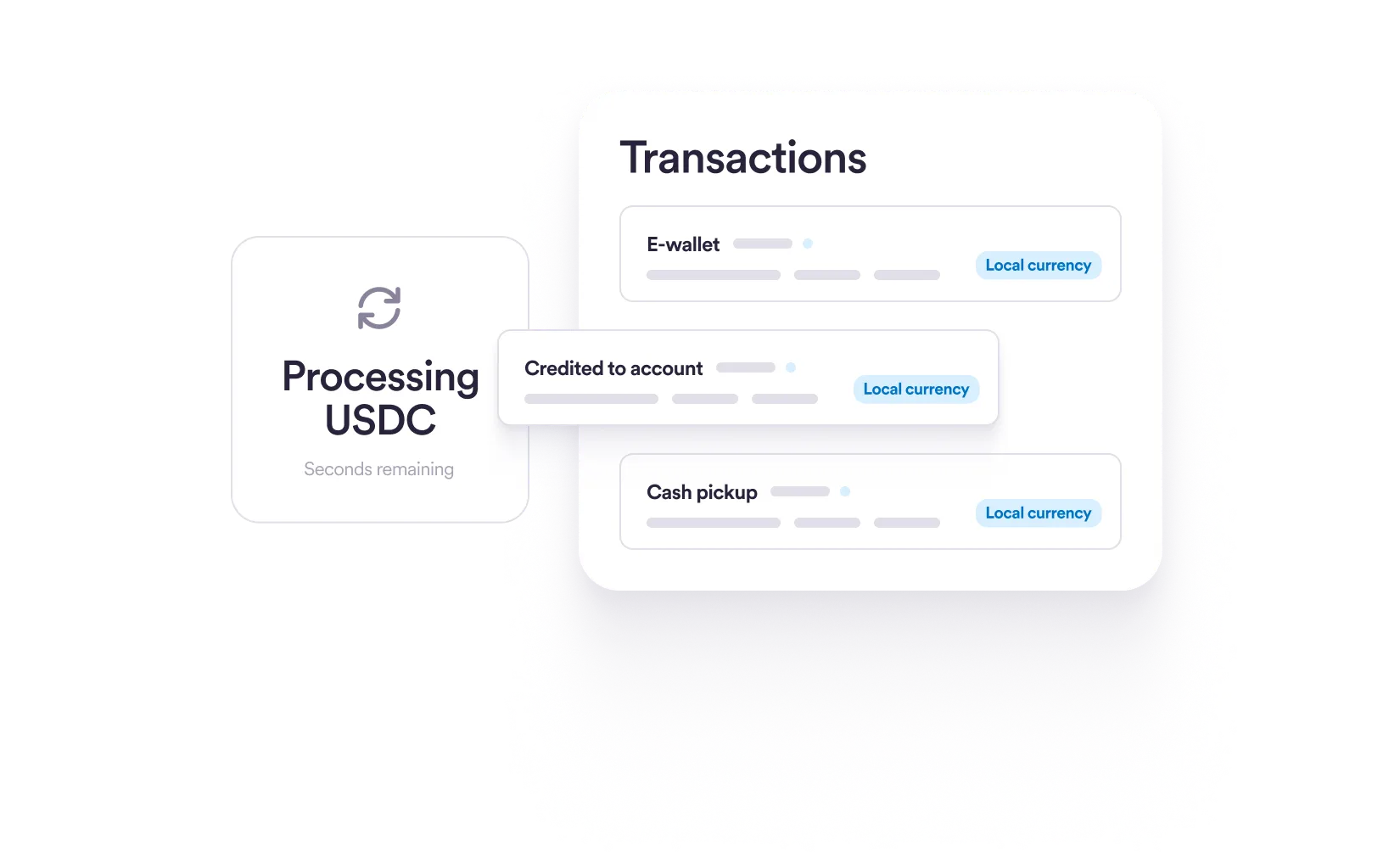
The on-ramp converts the sender’s fiat currency into USDC, while the off-ramp converts USDC back into local currency for the recipient. Leading providers like Stripe and Fireblocks offer integrated APIs that handle KYC/AML compliance and fiat settlement simultaneously. Choosing a partner with strong local banking relationships in both the origin and destination countries is critical to avoiding transaction failures.
USDC operates on multiple blockchains, each with different cost and speed profiles. Ethereum Mainnet offers high security but can be expensive during peak times. Layer-2 solutions like Base or Arbitrum provide near-instant settlement with minimal fees. For remittance, prioritize networks with deep liquidity and established merchant acceptance to ensure the recipient can easily cash out.

Liquidity providers (LPs) ensure that USDC remains pegged to the USD and that there is sufficient depth to handle transaction volumes without slippage. Fireblocks and other institutional custodians often partner with LPs to guarantee that fiat conversions happen at market rates. This layer is invisible to the end user but essential for maintaining the "1:1" promise that makes USDC viable for remittances.

The final step is the actual transfer of value over the chosen blockchain. Because USDC is a tokenized dollar, the transfer is atomic and final within minutes. Unlike SWIFT, which may take days, blockchain settlement is deterministic. This speed allows remittance businesses to reduce working capital requirements, as funds are no longer tied up in transit for days at a time.
The technical architecture of USDC remittances is designed to eliminate the friction of traditional cross-border payments. By separating the fiat conversion from the blockchain transfer, businesses can optimize each leg of the journey independently. This modularity allows for greater control over costs and settlement times.
| Feature | Traditional (SWIFT) | USDC Infrastructure |
|---|---|---|
| Settlement Time | 1-3 Business Days | < 1 Minute |
| Cost Structure | High Fees + FX Spread | Network Gas + Low Spread |
| Transparency | Opaque Tracking | On-Chain Public Ledger |
| Working Capital | Tied Up in Transit | Released Immediately |
This infrastructure shift moves remittances from a banking-centric model to a token-centric one. The result is a faster, more transparent, and significantly cheaper way to move money across borders.


As an Amazon Associate, we may earn from qualifying purchases.
Real-world USDC remittance market research
The shift from theoretical benefits to actual deployment is now evident in the remittance sector. Major players are moving beyond pilot programs to integrate USDC into their core settlement rails, driven by the need to reduce friction in cross-border payments. This section examines how established fintechs and FX providers are leveraging stablecoins to solve legacy inefficiencies.
Market data and provider-backed metrics
To understand the current valuation and liquidity of the asset underpinning these strategies, it is essential to track USDC's market performance alongside broader stablecoin trends. Live data ensures you are making decisions based on current liquidity conditions rather than stale snapshots.
Case studies: BCRemit and Onafriq
BCRemit, a remittance provider focused on the African market, integrated Circle’s USDC to streamline payouts. By bypassing traditional correspondent banking networks, BCRemit reduced settlement times from days to minutes. The integration allowed them to offer more competitive exchange rates and lower fees, directly addressing the high-cost barrier that often excludes unbanked populations.
Similarly, Onafriq partnered with Circle to power cross-border payments across Africa. This collaboration leverages USDC’s stability to mitigate FX volatility risks for both the provider and the end-user. The result is a simplified payment flow that maintains compliance while accelerating the speed of money movement.
Traditional vs. USDC remittance metrics
The operational differences between legacy systems and USDC-based settlements are stark. The table below compares key performance indicators, highlighting the efficiency gains achieved by adopting stablecoin infrastructure.
| Metric | Traditional Wire | USDC Settlement |
|---|---|---|
| Settlement Time | 1-5 business days | Minutes |
| Average Cost | $15-$30 per transfer | <$0.01 per transfer |
| FX Exposure | High (interbank spreads) | Low (stable peg) |
| Accessibility | Requires bank account | Mobile wallet accessible |
Image: BCRemit USDC Integration
Why USDC dominates remittance
The preference for USDC over other stablecoins in this sector is not accidental. Its 1:1 backing by U.S. dollar reserves held in regulated institutions provides a level of transparency that financial institutions require. Monthly attestations from independent auditors and daily reporting on the reserve portfolio mitigate counterparty risk, making it the safest choice for high-volume remittance flows.
This combination of speed, low cost, and regulatory clarity validates the USDC remittance strategy. As more providers adopt this infrastructure, the network effect will further reduce costs and increase accessibility, making faster settlements the new standard rather than the exception.
Regulatory and Safety Requirements
Building a USDC remittance strategy requires more than just selecting a wallet; it demands a rigorous compliance framework. For finance professionals, the primary concern is mitigating counterparty and regulatory risk. Unlike traditional banking, where capital requirements are opaque, USDC offers a transparent reserve structure that simplifies audit trails. This transparency is not just a feature—it is a requirement for institutional adoption.
USDC is backed 1:1 by US dollars held in regulated U.S. banks and short-term U.S. Treasuries. Circle publishes monthly attestations from independent auditors, providing a clear view of the reserve composition. This level of disclosure reduces the opacity that often plagues cross-border settlement layers. For remittance providers, this means less time spent on due diligence and more time on execution.
Security in this space is equally critical. Integrating with institutional-grade custodians like Fireblocks or payment rails like Stripe provides a buffer against smart contract vulnerabilities and operational errors. These partners offer multi-party computation (MPC) wallets and real-time transaction monitoring, which are essential for meeting anti-money laundering (AML) standards. By layering these technologies, you create a settlement pipeline that is both fast and compliant.
The regulatory landscape is shifting toward clarity, not prohibition. The Financial Action Task Force (FATF) has issued guidance that treats stablecoins similarly to traditional payment methods, provided they meet specific reserve and transparency criteria. This alignment allows USDC to fit into existing compliance workflows rather than requiring entirely new systems. As regulations evolve, sticking to fully reserved, audited stablecoins like USDC positions your strategy to adapt quickly.
Technical Architecture Overview
To fully grasp the efficiency gains, it is helpful to visualize the transaction flow compared to legacy systems. The following chart illustrates the latency and cost differences between SWIFT transfers and USDC settlements on high-throughput networks.
Frequently asked questions about USDC remittances
How do stablecoins work for cross-border payments?
Stablecoins reduce the friction of cross-border settlement by allowing near-instant transfers. In a typical flow, the sender converts local currency to a stablecoin and transmits it across a blockchain network within minutes. The recipient then converts it back into their local fiat currency, bypassing traditional banking rails that often require pre-funded accounts or days to clear.
Is USDC 100% safe?
USDC is designed to maintain a stable value by being backed by a reserve of U.S. dollars. Its operation relies on a carefully orchestrated process to guarantee its stability and parity with the dollar. However, "100% safe" is a strong claim in finance; while USDC is one of the most transparent stablecoins available, users should always understand the underlying smart contract and custodial risks involved in any digital asset transaction.
How is USDC backed by USD?
Each USDC is backed by U.S. Dollar reserves held in regulated U.S. banks and is fully redeemable 1:1 for USD. Circle publishes monthly attestations from independent auditors to verify these reserves. These reserves consist of highly liquid assets like cash and short-term U.S. Treasuries, ensuring that the token remains pegged to the dollar even during market volatility.
Is putting money in USDC safe?
USDC provides transparency and trust through its reserve management. The reserves are safely held by leading financial institutions, and daily, independent, third-party reporting on the portfolio of assets is publicly available. This level of scrutiny makes it a preferred choice for institutional remittance strategies compared to less regulated alternatives.
No comments yet. Be the first to share your thoughts!