Why USDC reshapes cross-border payments
Traditional remittance rails are built for an analog world. Sending money across borders through legacy banks or wire services often means waiting days for settlement while fees eat into the principal. USDC changes this dynamic by leveraging blockchain infrastructure to move value with the speed and transparency of digital information.
The core advantage is cost efficiency. By bypassing intermediary banks and correspondent networks, USDC transactions can reduce fees by up to 50% compared to traditional money transfer services. This is not a marginal improvement; for families relying on remittances, those savings represent significant purchasing power in local economies. The Stripe resources on stablecoin remittances highlight how converting local currency to a stablecoin allows direct wallet-to-wallet transfers, eliminating the markup layers inherent in fiat corridors.
Speed is equally transformative. While a standard international wire may take three to five business days to clear, a USDC transfer settles in minutes, regardless of holidays or time zones. This immediacy provides liquidity to recipients who often cannot wait for funds to arrive. The reliability of this system rests on USDC’s peg to the US dollar, maintained by holding fiat reserves equal to the circulating supply, ensuring that the digital token retains its value during transit.
USDC vs. Traditional Money Transfer Costs
When sending money across borders, the total cost is rarely just the transfer fee. Exchange rate margins often hide the real expense, quietly shaving a percentage off the principal before the recipient even sees the funds. Traditional providers like Western Union or Wise typically charge a visible fee plus a spread of 2-4% on the currency conversion. USDC, by contrast, trades at or near its $1 peg, meaning the sender and receiver agree on the exact value being moved without a middleman adding a markup.
To illustrate the difference, consider a standard $500 transfer to high-volume corridors like Colombia or the Philippines. Traditional services often result in the recipient receiving significantly less than the face value due to combined fees and poor exchange rates. With USDC, the primary costs are the blockchain network gas fee and the exchange spread when converting to local fiat, which can be fractions of a cent on networks like Polygon or Solana.
The table below breaks down the estimated costs for a $500 transfer to the Philippines, comparing the total amount deducted from the sender's $500 against what the recipient actually receives. These figures represent average market conditions and can vary based on specific provider pricing models and network congestion.
| Provider Type | Transfer Fee | FX Margin | Total Cost | Recipient Receives |
|---|---|---|---|---|
| Traditional (WU/Wise) | $5.00 - $10.00 | 2% - 4% | $15.00 - $30.00 | $470.00 - $485.00 |
| USDC (Polygon) | $0.01 - $0.10 | 0.1% - 0.5% | $0.50 - $2.50 | $497.50 - $499.50 |
| USDC (Solana) | $0.001 - $0.01 | 0.1% - 0.5% | $0.20 - $2.00 | $498.00 - $499.80 |
As the data shows, the gap widens as the transfer amount increases. For larger remittances, the percentage-based margin of traditional providers becomes a substantial drain on household income. USDC’s fixed, minimal overhead ensures that the majority of the principal reaches its destination. This efficiency is particularly critical for families relying on remittances for daily expenses, where every dollar saved translates directly to food, rent, or education.


As an Amazon Associate, we may earn from qualifying purchases.
Backend infrastructure choices
Building a scalable USDC remittance operation requires more than just a stablecoin; it demands a specialized backend that bridges traditional banking compliance with blockchain efficiency. The core operational promise of stablecoin-based remittances is near-instant, always-on cross-border settlement without the need for pre-funded local accounts. This structural shift eliminates the capital drag of nostro/vostro accounts, allowing providers to free up working capital while maintaining strict regulatory oversight.
Providers typically layer two distinct infrastructure components to achieve this. First, a digital asset custody and transaction management platform, such as Fireblocks, handles the secure movement of funds. These platforms provide multi-party approval workflows and transaction policy engines that satisfy institutional risk managers. By automating compliance checks at the transaction level, providers can scale volume without proportionally increasing their compliance headcount.
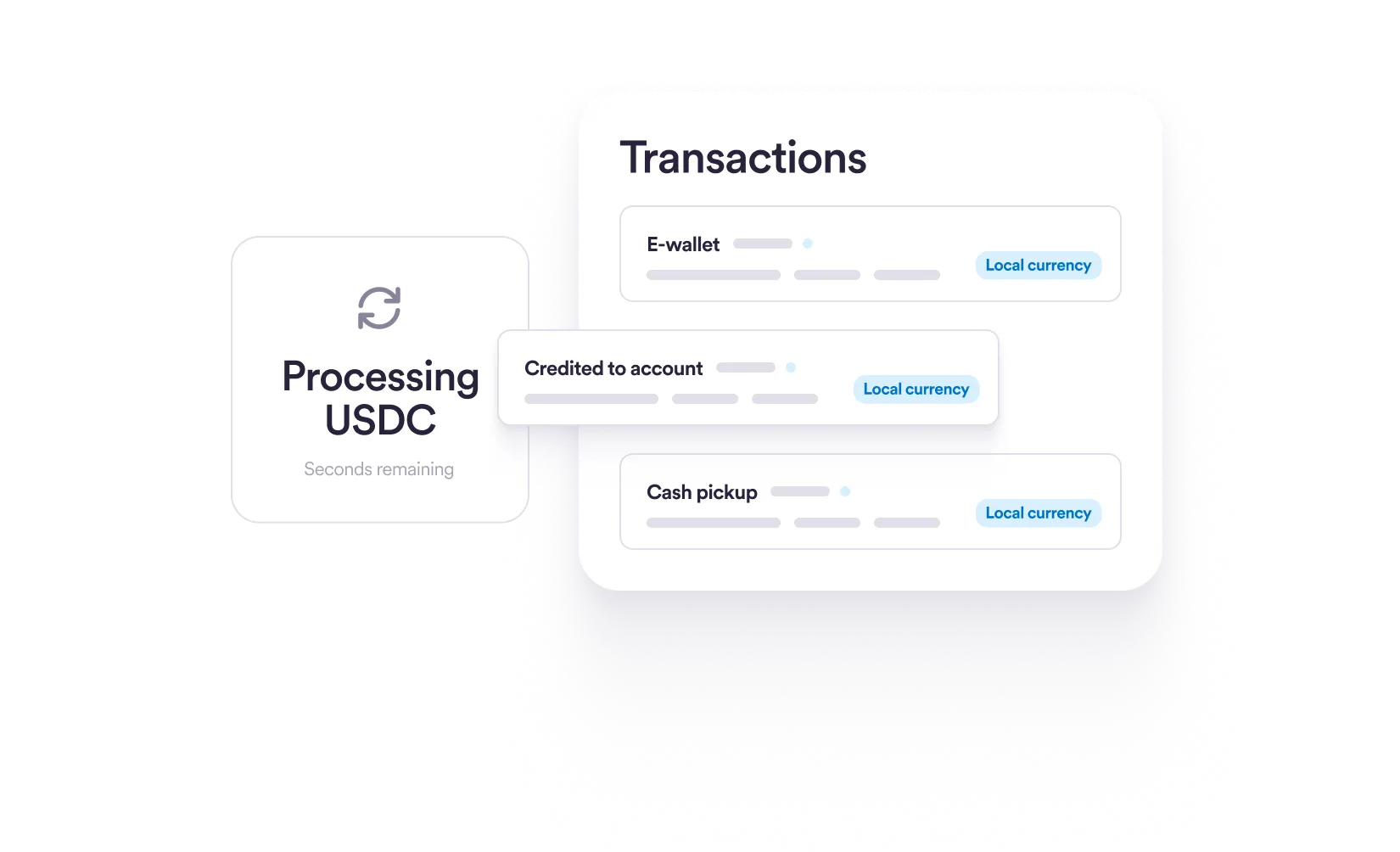
Second, the settlement layer relies on networks like the Circle Payments Network. This infrastructure allows remittance providers to mint, transfer, and redeem USDC directly on-chain or through integrated APIs. The result is a streamlined flow: fiat enters, converts to USDC, moves instantly across borders, and converts to local fiat for the recipient. This architecture reduces settlement times from days to seconds, directly lowering the cost of capital for the provider.
The combination of institutional-grade custody and efficient settlement rails creates a robust foundation. Providers like BCRemit have leveraged this stack to redefine the user experience, making cross-border payments faster and cheaper than traditional wire transfers. For remittance businesses, the choice of backend infrastructure is no longer just about technology—it is a strategic decision that directly impacts margin, speed, and regulatory compliance.
Adoption trends in Latin America and Africa
The shift toward stablecoin remittances is no longer theoretical; it is actively reshaping high-volume corridors in Latin America and Africa. In these regions, where traditional banking infrastructure often struggles with speed and cost, USDC has moved from a speculative asset to a critical utility for cross-border value transfer.
In Latin America, the adoption curve is steepening as financial institutions integrate USDC to bypass legacy settlement delays. Mastercard’s recent analysis highlights how crypto and fiat hybrids are becoming standard in corridors like Mexico to the United States. Providers are leveraging USDC to offer near-instant finality, directly addressing the friction that plagues traditional wire transfers. This isn't just about lower fees; it's about liquidity availability for families who rely on remittances for daily expenses.
Similarly, in Africa, the narrative is driven by financial inclusion. With over 60% of the population lacking full banking access, mobile-first stablecoin solutions are filling the gap. USDC’s stability makes it a reliable store of value and medium of exchange in volatile local currency environments. By settling in USDC, users avoid the double conversion costs and time delays inherent in traditional correspondent banking networks.
The data supports this structural shift. As regulatory clarity improves in key markets, institutional adoption is accelerating, creating a more robust infrastructure for remittance providers. This trend is expected to continue, making USDC a foundational layer for the next generation of global payments.
Regulatory risks and compliance requirements
Building financial infrastructure with USDC is not just a technical upgrade; it is a legal minefield. Remittance providers must navigate a complex web of Know Your Customer (KYC) and Anti-Money Laundering (AML) regulations that vary significantly by jurisdiction. Unlike traditional banking, where compliance frameworks are often decades old, stablecoin remittances operate in a rapidly evolving regulatory landscape where rules are being written in real-time.
The core operational promise of stablecoin-based remittances is near-instant, always-on cross-border settlement without the need for pre-funded local accounts. However, this efficiency comes with heightened scrutiny. Financial Action Task Force (FATF) guidelines require strict adherence to the "travel rule," meaning providers must collect and transmit originator and beneficiary information for transactions above certain thresholds. Failure to comply can result in severe penalties, including the revocation of money transmitter licenses.
Providers must also ensure that their stablecoin reserves are fully backed and transparently audited. USDC, issued by Circle, maintains a $1 peg by holding fiat currency equal to the amount of circulating USDC, but regulatory bodies like the US Treasury and the Federal Reserve are increasingly focused on the stability and reserve composition of stablecoins. This scrutiny extends to the underlying blockchain infrastructure, where providers must monitor for sanctioned addresses and illicit activity.
The stakes are high. A single compliance breach can halt operations across multiple regions. Providers are investing heavily in automated compliance tools and blockchain analytics to detect suspicious patterns before they escalate. This is not just about avoiding fines; it is about maintaining the trust of institutional partners and end-users who rely on the stability and legality of the remittance channel.
Frequently asked questions about USDC remittances
How does USDC stay pegged to the dollar?
USDC maintains its $1 peg by holding reserves equal to its circulating supply. Circle, the issuer, keeps these reserves in short-duration US Treasury bills and cash deposits. This 1:1 backing ensures that for every USDC in circulation, there is an equivalent dollar asset available for redemption, providing the stability needed for remittance flows.
Is USDC 100% safe?
While USDC is widely trusted, no stablecoin is entirely risk-free. Its safety relies on Circle’s reserve management and regulatory compliance. Unlike Bitcoin, USDC does not appreciate in value, so its primary utility is preserving purchasing power during cross-border transfers rather than generating investment returns.
Is USDC better than USDT for remittances?
Tether (USDT) holds a larger market cap, but USDC often leads in transaction volumes and transparency. USDC’s regular attestation reports and stricter regulatory stance make it a preferred choice for institutional remittance corridors where compliance and auditability are critical. USDT remains dominant in retail trading but carries higher counterparty opacity.
Can I use USDC for international money transfers?
Yes. USDC operates on multiple blockchains, including Solana, Ethereum, and Polygon, allowing for fast, low-cost international transfers. Users can send USDC directly to recipients who hold compatible wallets, bypassing traditional banking rails and reducing fees significantly compared to wire transfers.
No comments yet. Be the first to share your thoughts!