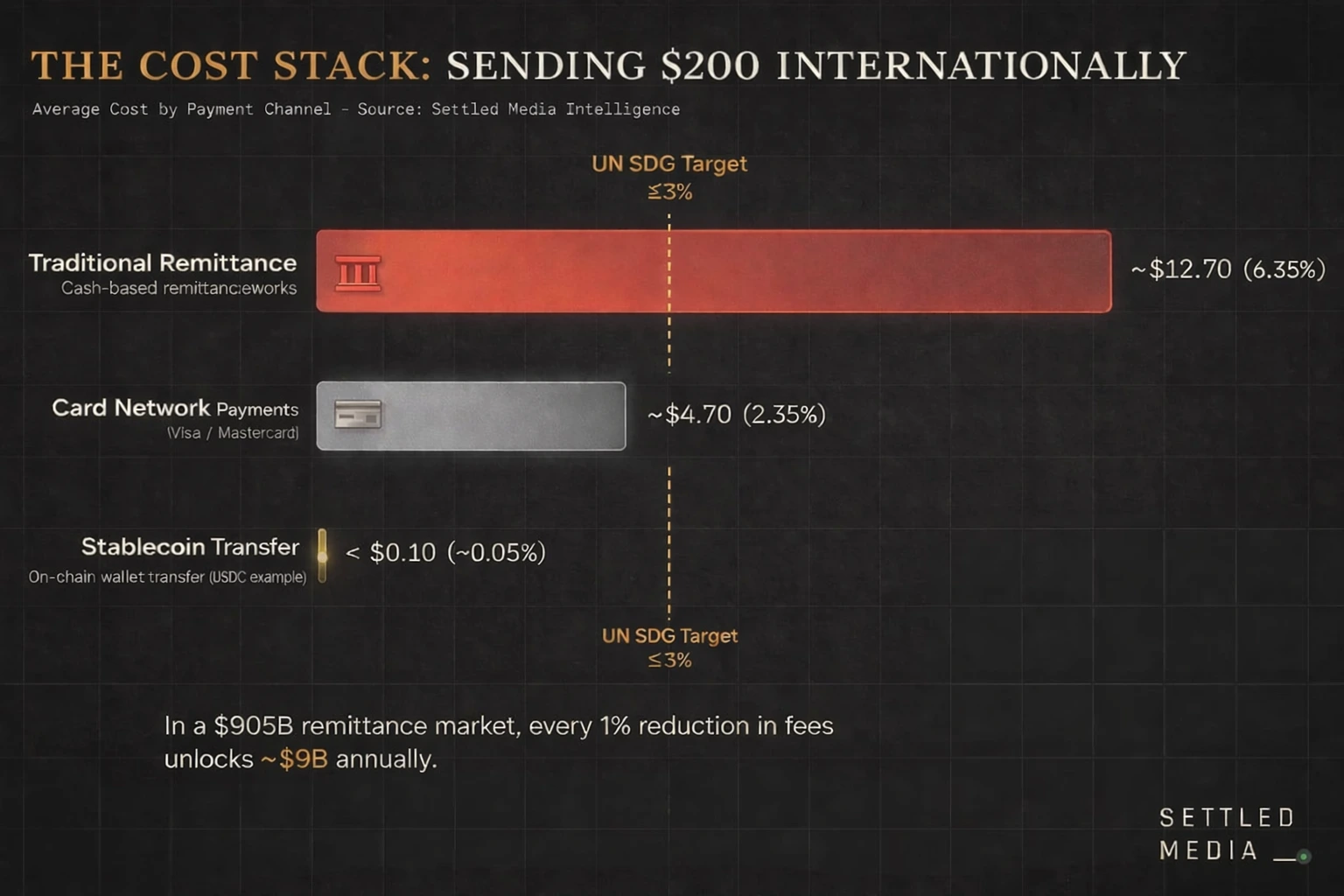
USDC remittance market research
USDC remittance market research reveals that cost efficiency is not guaranteed. While stablecoins offer speed, a recent Banca d'Italia study shows total costs range from 0.3% to nearly 9% depending on the corridor and on-ramp methods used. This variability means USDC is not automatically cheaper than traditional providers like Western Union or Wise.
The technology behind USDC transfers operates on public blockchains, which allows for faster settlement than legacy banking rails. However, the "last mile"—converting digital dollars back to local currency—often introduces hidden fees. Research indicates that while the blockchain transfer itself is cheap, the exchange rate spreads and withdrawal fees can negate those savings for smaller amounts.
| Feature | USDC Remittances | Traditional Wire | Digital Wallets (Wise/PayPal) |
|---|---|---|---|
| Settlement Time | Minutes to Hours | 1-3 Business Days | Minutes to Hours |
| Cost Range | 0.3% - 9% (Variable) | Fixed Fee + FX Spread | Low Fixed Fee + Transparent FX |
| Transparency | High on-chain, low off-chain | Low | High |
| Best For | Large volumes, tech-savvy users | Formal banking records | Everyday small transfers |
The decision to use USDC depends on your specific use case. For large, infrequent transfers where speed is critical, USDC often wins. For smaller, regular remittances, established fintech apps with transparent fee structures may still offer better value. Always calculate the total landed cost, including conversion fees, before choosing a provider.
Usdc remittance market research choices that change the plan
Choosing a stablecoin rail for cross-border payments requires weighing speed against hidden friction. While USDC offers deep liquidity on major chains, the total cost of transfer rarely matches the headline fees. A Banca d'Italia study found that stablecoin transfers showed no systematic cost advantage, with total costs ranging between 0.3% and nearly 9% depending on the corridor and exit methods [src-1]. This variance means that infrastructure choices must align with specific transaction volumes and compliance requirements.
The following comparison evaluates four common approaches to USDC remittances. Each method balances initial fees, settlement speed, and regulatory complexity differently. Use this framework to identify which tradeoffs align with your operational capacity and target market.
| Method | Estimated Cost | Settlement | Primary Risk |
|---|---|---|---|
| Direct On-Chain | Low ($0.10–$2) | Minutes | Volatility & Gas |
| Stablecoin Remittance App | Medium (1–3%) | 1–24 Hours | Counterparty |
| Bilateral FX Bridge | High (3–9%) | Same Day | Compliance |
| Traditional Wire (SWIFT) | High ($15–50) | 1–3 Days | Liquidity |
For real-time market context, USDC’s peg stability and trading volume on major exchanges like Binance provide a baseline for liquidity assessment. A stable peg is essential for remittance reliability, as deviations directly impact the value received by beneficiaries.
Evaluating the choices that change the plan
Direct on-chain transfers offer the lowest explicit fees but require users to manage gas costs and wallet security. This method suits tech-savvy corridors where end-users can handle self-custody. However, network congestion can spike costs unpredictably, making budgeting difficult for fixed-fee services.
Stablecoin-focused remittance apps bridge the gap between crypto and traditional finance. They handle on-ramping and off-ramping, reducing user friction. The tradeoff is higher implicit fees and reliance on the platform’s operational integrity. For businesses, this model offers better compliance reporting but less control over the underlying settlement rail.
Bilateral FX bridges using USDC as a liquidity layer often incur higher costs due to intermediary markups and regulatory overhead. These models are viable only when traditional banking rails are inaccessible or prohibitively slow. The primary risk here is regulatory scrutiny, as these platforms operate in a complex legal gray area in many jurisdictions.
Traditional SWIFT transfers remain the most expensive and slowest option, yet they offer the highest level of institutional trust. For large enterprise payments, the certainty of settlement and established dispute resolution mechanisms often justify the cost. USDC remittances compete best in mid-volume corridors where speed and transparency outweigh the need for legacy banking infrastructure.
Build a USDC Remittance Decision Framework
Stablecoin remittances are no longer a theoretical cost-saving experiment. Recent data confirms that total transfer costs range from 0.3% to nearly 9%, depending on the corridor and liquidity conditions [[src-serp-1]]. To implement USDC remittances effectively, you must move beyond simple price comparisons and evaluate infrastructure reliability, regulatory compliance, and final recipient value.
1. Audit Network Costs and Liquidity
Do not rely on the base transaction fee alone. Your true cost includes the spread between the stablecoin price and the local fiat currency, plus withdrawal fees charged by the receiving exchange. Liquidity varies significantly by corridor; sending USDC to a high-volume pair like EUR/USDC or GBP/USDC usually results in tighter spreads than emerging market currencies. Always calculate the final amount received in local currency, not just the USD equivalent.
2. Verify Regulatory and Compliance Status
Stablecoin remittances face increasing scrutiny. Ensure your provider is compliant with local anti-money laundering (AML) regulations and that the receiving entity is licensed to handle digital assets. The Banca d'Italia study highlights that while stablecoins offer speed, they face a "reality check" regarding systematic cost advantages and regulatory alignment [[src-serp-1]]. Using a compliant provider reduces the risk of frozen funds or account closures.
3. Compare Final Recipient Value
Create a comparison table for your specific corridor. Include the traditional provider (e.g., Western Union, Wise) and the USDC provider. Factor in:
- Upfront fees: Transaction charges.
- FX spread: The difference between the mid-market rate and the exchange rate.
- Withdrawal time: How long until the recipient can use the funds.
- Total cost percentage: The sum of fees and spread as a percentage of the transfer.
4. Implement a Hybrid Strategy
For high-stakes or large-volume remittances, consider a hybrid approach. Use traditional banks for regulatory certainty and smaller, frequent transfers. Use USDC for larger amounts where speed and lower fees outweigh the complexity of digital asset handling. This diversification protects against network congestion or sudden regulatory changes.
5. Monitor Market Conditions
Crypto markets are volatile. While USDC is pegged to the dollar, the underlying blockchain networks can experience congestion, leading to higher gas fees. Monitor network status before initiating large transfers. Use a technical chart to observe broader market trends that might impact liquidity or exchange rates during your transfer window.
6. Test with Small Amounts
Before committing to regular use, send a small test amount to your recipient. Verify that the funds arrive intact, within the expected timeframe, and that the recipient can successfully withdraw them to their local bank account. This step validates the entire flow, from your wallet to the final fiat conversion.


As an Amazon Associate, we may earn from qualifying purchases.
The Hidden Costs of USDC Remittances
Marketing materials often promise near-zero fees for USDC transfers, but the reality is more complex. A Banca d’Italia study found that total costs for stablecoin transfers ranged between 0.3% and nearly 9%, depending on the network used and exit points [[src-serp-1]]. While the blockchain transaction fee might be pennies, the cost to convert fiat into USDC and back out again can erode margins significantly.
Common Mistakes to Avoid
Many senders overlook the "slippage" cost when moving between centralized exchanges. If you are sending USDC from the US to Europe, you might save on the transfer itself, but the spread when buying USDC with dollars can add 0.5% to 1%. Always calculate the full chain: fiat-to-stablecoin, blockchain transfer, and stablecoin-to-fiat.
When USDC Makes Sense
USDC is most efficient for large, infrequent transfers where the fixed percentage fee of traditional services like Western Union becomes prohibitive. For small, regular remittances under $500, the overhead of managing crypto wallets and exchange fees often outweighs the benefits. Use USDC when speed is critical and the transfer amount justifies the complexity.
Usdc remittance market research: what to check next
The stablecoin remittance market is projected to grow from $4.2 billion in 2025 to $32.8 billion by 2034, driven by institutional infrastructure upgrades (marketintelo.com). However, cost efficiency is not guaranteed for every sender.
No comments yet. Be the first to share your thoughts!