Why USDC beats traditional rails
Traditional cross-border payments rely on legacy networks like SWIFT, which were built for an era of physical checks and telegrams. These systems operate through a chain of correspondent banks, each taking a cut and adding time to the settlement process. For a business sending money internationally, this means waiting days for funds to clear and paying significant fees just to move capital across borders. The infrastructure is fragmented, opaque, and fundamentally slow.
USDC changes this by acting as a direct settlement layer. Because it is a stablecoin pegged to the US dollar, it offers the price stability businesses need without the volatility of other cryptocurrencies. More importantly, it leverages blockchain technology to settle transactions in minutes, not days. This speed isn't just a convenience; it's a capital efficiency tool. When money moves faster, businesses can reinvest it sooner, improving cash flow and reducing the need for large, idle reserve accounts in foreign currencies.
The economic advantage is clear. By bypassing the intermediary banking layer, USDC transfers significantly reduce transaction costs. Platforms like Stripe now allow businesses to send and receive USDC without needing to directly manage crypto wallets, making the integration seamless for existing financial workflows. This infrastructure shift means lower fees for senders and receivers, making international trade and remittances more accessible and affordable for everyone involved.
To understand the current market context, it helps to see how USDC performs in real-time trading environments.
USDC vs. Traditional Remittance: Costs and Speed
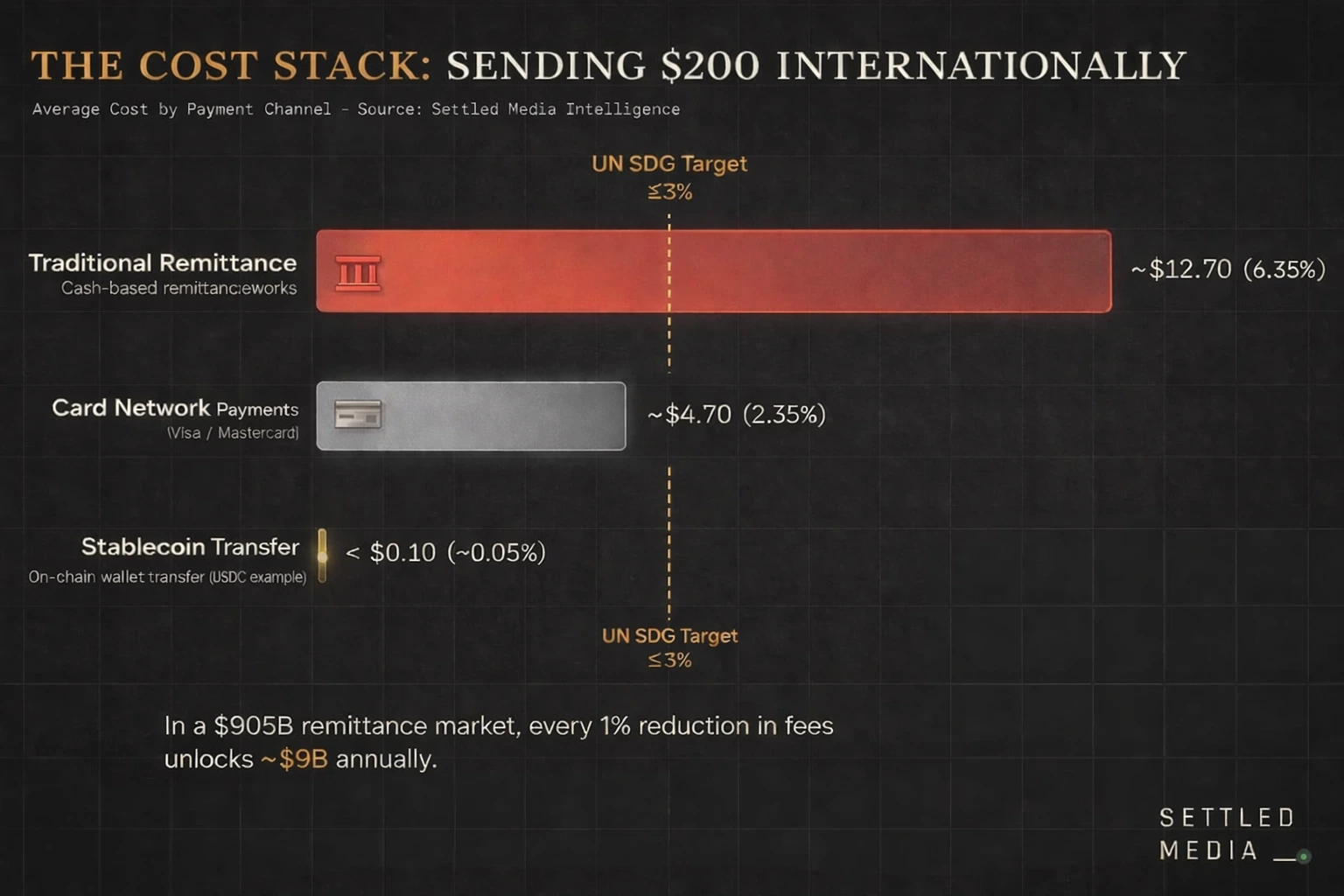
Moving money across borders is rarely free, but the cost structure has shifted dramatically. Traditional providers like Western Union and Wise charge fees that are often tied to transfer size and payment method, while USDC relies on blockchain network fees and exchange spreads. For high-volume or urgent transfers, the difference in both price and time is substantial.
Traditional money transfer services typically charge a flat fee plus a percentage of the transfer amount, often resulting in total costs between 5% and 10% for smaller transfers. Wise, known for its transparency, offers lower fees but still operates within traditional banking hours and settlement cycles, which can take 1-3 business days. Western Union, while ubiquitous, often includes hidden exchange rate markups that can exceed 4% on the underlying currency conversion.
USDC, by contrast, operates on a 24/7 infrastructure. Settlement is near-instant, occurring in minutes rather than days. The primary costs are the blockchain gas fee (often less than $1 on networks like Solana or Base) and the spread when converting fiat to USDC. This makes USDC particularly attractive for remittances where speed is critical and the transfer amount is large enough that percentage-based fees from traditional providers become prohibitive.
The following table compares the typical metrics for a $500 transfer from the US to Colombia, a common remittance corridor. These figures are illustrative based on current market conditions and may vary by provider and network congestion.
| Provider | Estimated Fee | Settlement Time | 24/7? |
|---|---|---|---|
| Western Union | $5-15 + spread | Minutes (pickup) / 1-3 days (bank) | Yes |
| Wise | ~$4-8 + mid-market rate | 1-3 business days | No |
| USDC (Solana) | <$0.01 gas + exchange spread | < 1 minute | Yes |
| USDC (Ethereum) | $1-5 gas (varies) + spread | < 5 minutes | Yes |
While USDC offers clear advantages in speed and cost for tech-savvy users, it requires a digital wallet and an on-ramp/off-ramp service. Traditional providers offer physical accessibility and customer support, which can be crucial for recipients in areas with limited banking infrastructure. However, for those with access to digital wallets, USDC provides a significantly more efficient settlement stack.
Core Infrastructure Components
Building a reliable USDC remittance strategy requires stitching together five distinct technical layers. It is not enough to simply hold tokens; you need a stack that handles custody, settlement, and final cash-out without friction. A functional payout system for cross-border payments typically consists of wallets, chains, on- and off-ramps, invoicing tools, and reconciliation systems.
Digital Wallets and Custody
The foundation of any remittance stack is the digital wallet. For businesses, this usually means a multi-signature wallet or a custodial solution from a regulated provider. These wallets hold the USDC and sign transactions, acting as the secure vault for your capital. Using a provider like Stripe can simplify this layer, allowing you to send and receive USDC without managing private keys directly. This reduces operational risk while maintaining control over funds.
Blockchain Selection
Not all blockchains are equal for remittance. You need a chain with high throughput and low fees to make small transfers viable. Solana, Stellar, and Polygon are popular choices because they offer near-instant settlement for fractions of a cent. Ethereum mainnet is generally too expensive for routine remittances, though layer-2 solutions like Arbitrum or Base are gaining traction. The chain you choose dictates the speed and cost of your settlement stack.
On- and Off-Ramps
The bridge between fiat and crypto is the most critical regulatory choke point. On-ramps convert local currency into USDC, while off-ramps convert USDC back into local fiat for the recipient. Reliable providers like Stripe, MoonPay, or local exchange partners handle the KYC/AML compliance. For African payouts, for example, integrating with local mobile money providers via a dedicated off-ramp is often more effective than bank transfers. The reliability of these ramps determines whether your funds actually reach the user.
Reconciliation and Invoicing
Finally, you need software to track where every dollar goes. Invoicing tools generate reference numbers for each transaction, while reconciliation systems match on-chain hashes to your internal ledger. Without this layer, accounting becomes a manual nightmare. Automated reconciliation ensures that your financial records align with blockchain data, providing the audit trail needed for compliance and user trust.
Real-world case studies
Theoretical efficiency meets operational reality when companies like BCRemit, Mural Pay, and Onafriq integrate USDC into their settlement stacks. These examples show that stablecoin remittance is no longer an experimental side project but a core infrastructure choice for reducing friction in cross-border payments.
BCRemit has redefined the remittance experience by leveraging Circle’s USDC infrastructure. By moving away from traditional correspondent banking rails, they have made transfers faster, cheaper, and more accessible for users who previously faced high fees and long settlement delays. This shift demonstrates how stablecoins can directly improve the end-user experience in high-volume corridors.
In Latin America, Mural Pay addresses the specific pain points of SMEs operating in Colombia. By pairing virtual USD accounts with near-instant USDC on-chain transfers, they provide businesses with faster access to working capital while significantly reducing exposure to local peso volatility. This model highlights the utility of USDC not just for consumer transfers, but for business liquidity management.
Onafriq’s partnership with Circle further expands this utility across African remittance corridors. By simplifying global payments through USDC, Onafriq reduces the complexity and cost associated with traditional cross-border money transfers. These case studies collectively illustrate a growing trend: USDC is becoming the preferred settlement layer for remittance providers seeking speed, transparency, and cost efficiency.
Build your USDC remittance stack
Setting up a reliable cross-border payment system requires five core components: digital wallets, blockchain networks, on-ramps, off-ramps, and reconciliation tools. Think of this stack as the plumbing that moves value from sender to receiver without the friction of traditional banking rails.
Choose a sender wallet and a recipient wallet. For businesses, use a multi-signature wallet for security. For individuals, a non-custodial wallet like MetaMask or a custodial exchange account works well. Ensure both parties have access to the same blockchain network.
Not all blockchains are equal for remittances. Opt for low-fee, high-speed networks like Solana, Polygon, or Stellar. Avoid Ethereum mainnet for small transfers due to gas costs. The goal is speed and cost-efficiency, not just decentralization.
You need a way to convert fiat to USDC (on-ramp) and USDC to local currency (off-ramp). Services like Stripe, MoonPay, or local fiat gateways handle the on-ramp. For off-ramps, partner with local payout providers or use P2P markets to reach unbanked recipients.

Automate the tracking of payments. Use accounting software that supports crypto transactions to match USDC transfers with fiat payouts. This step is critical for tax compliance and preventing fraud. Clear records keep your business audit-ready.
Common usdc remittance: what to check next
You likely have practical concerns about moving money across borders. Here are direct answers to the most frequent questions regarding cashing out, choosing the right asset, and earning yield on stablecoins.
Helpful gear
Use these product recommendations as a starting point, then choose the size, material, and price point that fit how you actually use the gear.


As an Amazon Associate, we may earn from qualifying purchases.
No comments yet. Be the first to share your thoughts!