Why USDC remittances are gaining share
The scale of money leaving the United States is massive. According to the Foundation for the Advancement of International Reform (FAIR), the U.S. lost over $200 billion to foreign countries in remittances in 2021. This figure represents a significant jump from the roughly $150 billion leaving annually when the organization last examined the data in 2019. This growing outflow highlights the immense pressure on legacy rails and creates a fertile environment for more efficient infrastructure.
Legacy banking systems were not built for this volume of small, frequent cross-border payments. They rely on correspondent banking networks that introduce multiple intermediaries, each taking a cut and adding days to settlement times. For many senders, the friction isn't just the time it takes; it's the opaque fees that eat into the principal. As global digital infrastructure matures, USDC has emerged as a preferred alternative for 2026, offering a transparent, programmable layer that bypasses much of this traditional friction.
The shift isn't just about speed; it's about predictability. With USDC, senders know the exact cost before they initiate a transfer, and recipients often access funds within minutes rather than days. This efficiency is critical in a market where every dollar counts for families relying on these transfers for basic needs. As we analyze the 2026 landscape, it becomes clear that USDC isn't just a niche crypto play—it's becoming the standard for cost-effective remittance infrastructure.
USDC vs traditional remittance services
The choice between USDC and legacy money transfer services comes down to a trade-off between infrastructure speed and on-ramp friction. Traditional providers like Western Union and Wise have built extensive physical and banking networks that make sending money simple for the average person. However, this convenience comes with significant overhead costs.
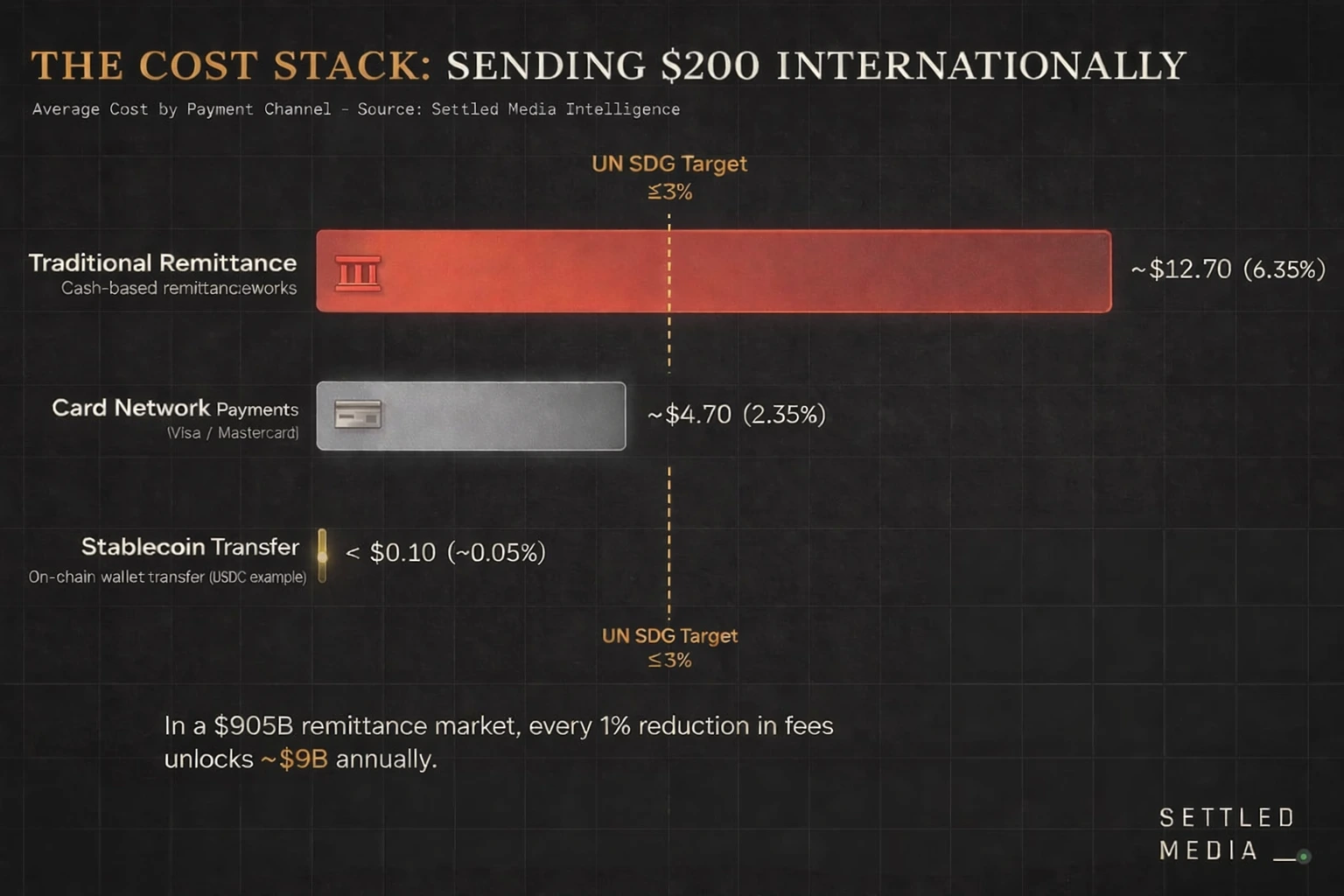
USDC operates on a different layer of the financial stack. It moves value through blockchain infrastructure, which allows for near-instant settlement regardless of banking hours or holidays. The cost structure is fundamentally different: instead of percentage-based fees and hidden exchange rate markups, USDC transfers rely on network gas fees, which are often negligible for larger amounts.
The following comparison looks at a standard US-to-LatAm remittance corridor (e.g., sending $500). This data highlights the structural differences in how value is moved and priced.
| Provider | Speed | Estimated Cost | Accessibility |
|---|---|---|---|
| USDC (via compliant platform) | 1–10 minutes | $0.10–$1.50 | Requires crypto wallet or on-ramp |
| Wise | 1–2 days | $4–$8 + FX markup | Bank account or card required |
| Western Union | Minutes (cash) to days | $5–$15 + FX markup | Physical agent locations or app |
| Remitly | Minutes to 3 days | $3–$10 + FX markup | Bank, card, or cash pickup |
While traditional services offer a familiar user experience, the cumulative cost of foreign exchange (FX) markups and transfer fees can eat up 5–10% of the sent amount. USDC, by contrast, typically costs less than 1% when using efficient stablecoin rails. The trade-off is that the recipient must have a way to convert the USDC into local currency, which adds a step that traditional services handle implicitly.
For businesses and high-volume senders, this difference is critical. As noted in industry analyses, pairing virtual USD accounts with USDC transfers allows SMEs to gain faster access to working capital and reduce exposure to local currency volatility. For individual senders, the savings are real but require a bit more technical comfort.
The USDC price widget above shows the stability that makes it suitable for remittances. Unlike volatile cryptocurrencies, USDC is designed to maintain a 1:1 peg with the US dollar, backed by reserves held in regulated financial institutions. This stability is why platforms like Stripe can integrate USDC for cross-border payments without requiring users to "touch" crypto directly.
If you are looking for tools to manage or track these transfers, the following products may help streamline your workflow.



As an Amazon Associate, we may earn from qualifying purchases.
Infrastructure shifts in 2026
The infrastructure powering USDC remittances has moved from experimental pilots to standardized rails. In 2026, the focus is less on speculative yield and more on operational reliability, regulatory clarity, and direct integration with traditional financial gateways.
Partnerships between stablecoin issuers and payment processors have become the primary mechanism for reducing friction. Companies like BCRemit and Onafriq now leverage Circle’s USDC to bypass legacy correspondent banking networks. These integrations allow remittance providers to settle funds in dollars while maintaining the speed of blockchain settlement. The result is a system where users receive money in minutes rather than days, with costs often dropping below 1% for larger transfers.
Regulatory clarity has also matured. With USDC recognized as a compliant dollar-backed stablecoin in key jurisdictions, institutions can hold it on balance sheets without the same capital reserves required for volatile cryptocurrencies. This status has encouraged larger fintechs and even traditional banks to build USDC corridors into their existing infrastructure, treating it as a digital cash equivalent rather than a crypto asset.
The technical backbone has stabilized as well. Most major remittance flows now utilize Layer 1 networks like Solana or Ethereum L2s for their finality and low fees. Meanwhile, fiat on-ramps and off-ramps have become more seamless. Platforms like Stripe enable businesses to send and receive USDC without ever touching a crypto wallet directly, effectively hiding the underlying blockchain complexity from both the sender and the recipient.
USDC/USD Stability and Liquidity
For remittance to work at scale, the stablecoin must maintain its peg with minimal slippage. USDC’s reserve composition—primarily short-term U.S. Treasuries and cash—provides a high degree of confidence in its $1.00 parity.
How USDC works in real remittance corridors
Theoretical cost savings only matter if the infrastructure actually moves money. Several companies have already built the rails, proving that USDC can handle the volume and speed requirements of cross-border payments.
BCRemit’s faster settlement model
BCRemit partnered with Circle to replace traditional banking corridors with on-chain USDC transfers. The result is a remittance experience that is faster and cheaper for users. By bypassing legacy intermediaries, BCRemit reduces the friction that typically delays funds and increases fees for senders.
MuralPay’s SME working capital solution
For small and medium-sized enterprises, time is money. MuralPay pairs virtual USD accounts with near-instant USDC transfers to help businesses access working capital faster. This approach reduces exposure to currency volatility, particularly for firms dealing with emerging market currencies like the Colombian peso. Instead of waiting days for wire clearance, SMEs get liquidity when they need it most.
Onafriq’s cross-border infrastructure
Onafriq has also integrated Circle’s technology to simplify global payments. By leveraging USDC, Onafriq streamlines the complex web of correspondent banking relationships. This partnership highlights how established payment providers are adopting stablecoin infrastructure to improve reliability and reduce costs for their clients.
How to build a USDC remittance stack
Building a USDC payout operation requires assembling five distinct infrastructure layers. If any single component fails, the entire transfer breaks. The stack consists of digital wallets, the blockchain network, on- and off-ramps, invoicing systems, and reconciliation tools. You need all five to move money reliably.
1. Digital Wallets
You need a custody solution to hold the USDC. For startups, non-custodial wallets offer lower fees but require strict key management. Institutional providers like Fireblocks or Copper offer multi-signature security, which reduces the risk of theft. Choose based on your risk tolerance and transaction volume.
2. Blockchain Networks
Selecting the right chain affects speed and cost. Solana and Polygon are popular for African remittances due to near-instant finality and fractions-of-a-cent fees. Ethereum mainnet is generally too expensive for small transfers. Always check current gas prices before initiating large batches.
3. On- and Off-Ramps
These are the bridges between fiat and crypto. You need a regulated on-ramp to buy USDC with USD and a compliant off-ramp to convert USDC into local currency for the recipient. Providers like Stripe, MoonPay, or local exchanges like Yellow Card facilitate these conversions. Ensure the off-ramp supports the specific local currency of your target market.
4. Invoicing and Reconciliation
Automated invoicing tracks who sent what and when. Without this, matching payments to specific orders becomes a manual nightmare. Use accounting software that integrates with your wallet provider to automatically log transactions. This reduces errors and simplifies tax reporting.
5. Reconciliation Tools
Finally, you need a system to verify that the recipient actually received the funds. Blockchain explorers provide transaction hashes, but you need a dashboard to confirm the off-ramp payout status. This closes the loop and provides proof of delivery for both you and your customer.
Frequently asked questions about USDC remittances
Can I cash out USDC to my bank account?
Yes, USDC is fully redeemable 1:1 for USD. You can sell USDC on major exchanges like Coinbase or Kraken and withdraw to your linked bank account via ACH or wire transfer. Alternatively, services like Eco allow direct transfers to local bank accounts in supported countries, bypassing traditional correspondent banking rails entirely.
Which cryptocurrency is best for remittance?
USDC is currently the most practical choice for most use cases. While stablecoins offer speed, USDC’s regulatory compliance and high liquidity make it easier to cash out without significant slippage. Bitcoin and Ethereum are slower and more volatile, while lesser-known stablecoins carry higher counterparty risks that can impact your recipient’s ability to access funds.
How do I earn interest on USDC?
You can generate yield by supplying USDC to decentralized finance (DeFi) protocols like Aave or Compound, or by using regulated money market funds that hold USDC. These methods typically offer higher returns than traditional savings accounts, though they come with smart contract risk or platform-specific terms that require careful review.
How much does the U.S. lose in remittances?
The U.S. lost over $200 billion to foreign countries in remittances in 2021, according to FAIR. These figures highlight the massive scale of cross-border payments and the potential cost savings that efficient infrastructure like USDC can provide compared to traditional money transfer operators.
No comments yet. Be the first to share your thoughts!