Why USDC Remittance Strategy Matters Now
The window for treating stablecoins as experimental tools is closing. By 2026, the regulatory landscape has hardened, but so has the infrastructure. For senders and receivers in high-volume corridors, the choice is no longer between "crypto" and "traditional finance," but between legacy rails that bleed value and stablecoin networks that preserve it.
The primary driver is cost efficiency. Traditional SWIFT transfers often involve multiple intermediary banks, each taking a cut and adding delays. A USDC remittance strategy bypasses this fragmentation. The sender converts fiat to USDC, transmits it on a low-fee blockchain, and the recipient converts it to local currency. This direct path slashes fees that can otherwise exceed 6-7% for smaller transfers, a critical margin for remittance-dependent households.
Speed is the second pillar. While traditional wire transfers can take three to five business days to settle, USDC transactions typically confirm in minutes. This immediacy provides liquidity to recipients who cannot wait days for funds to arrive, effectively turning a multi-day wait into a near-instant utility. As noted by industry leaders like Circle, the focus has shifted from mere speculation to reliable, compliant settlement infrastructure that works 24/7.
The 2026 market context rewards those who have already integrated this strategy. With major players like Mastercard and Fireblocks embedding stablecoin capabilities into their existing platforms, the friction of adoption is dropping. The technology is no longer a niche curiosity; it is a standard operational component for cost-conscious remittance flows.
USDC vs Traditional Money Transfer Costs
The headline difference between USDC and traditional rails is the fee structure. Traditional providers like Western Union and MoneyGram charge a percentage of the transfer amount, often ranging from 5% to 10% for smaller remittances. USDC transfers, by contrast, typically cost a flat network fee that remains constant regardless of the transfer size. This means that for larger remittances, the percentage cost of using USDC drops significantly, often by 50% or more compared to traditional services.
Exchange rate margins are the second major cost driver. Traditional providers embed a spread into the exchange rate, often charging 3-5% above the mid-market rate. USDC maintains a 1:1 peg to the US dollar, allowing users to convert to local currency at or near the mid-market rate. This eliminates the hidden tax on exchange rates that traditional services rely on.
| Feature | Traditional (WU/MG) | USDC (Stablecoin) |
|---|---|---|
| Transfer Fee | 3-10% of amount | $0.01 - $1.00 flat |
| Exchange Rate Spread | 3-5% above mid-market | 0-1% (near mid-market) |
| Settlement Time | Minutes to Days | Seconds to Minutes |
| Availability | Physical & Digital | Digital Only |
The speed advantage of USDC is not just a convenience; it reduces the risk of currency fluctuation during the transfer window. Traditional transfers can take 1-3 days to settle, exposing both sender and recipient to market volatility. USDC settles in seconds, locking in the exchange rate at the moment of transfer.
| Feature | Traditional (WU/MG) | USDC (Stablecoin) |
|---|---|---|
| Transfer Fee | 3-10% of amount | $0.01 - $1.00 flat |
| Exchange Rate Spread | 3-5% above mid-market | 0-1% (near mid-market) |
| Settlement Time | Minutes to Days | Seconds to Minutes |
| Availability | Physical & Digital | Digital Only |



As an Amazon Associate, we may earn from qualifying purchases.
Key Infrastructure Players in 2026
Moving beyond the token itself, the real advantage of USDC remittances lies in the middleware and settlement layers that handle the heavy lifting. In 2026, the infrastructure has matured from experimental pilots to robust, institutional-grade rails. The critical players—ranging from core stablecoin issuers to specialized custody and compliance networks—enable the speed and cost savings that define this strategy.
At the base layer, Circle remains the primary settlement provider. Its direct integration with major payment processors ensures that USDC moves with the reliability expected of traditional banking, but at a fraction of the cost. This is not just about holding the asset; it is about the seamless on-ramp and off-ramp capabilities that allow remittance companies to operate without managing multiple local bank relationships.
On the compliance and custody side, Fireblocks has become the standard for secure transaction execution. Their infrastructure allows remittance providers to manage multi-signature wallets and automate compliance checks in real-time. This is crucial for avoiding the delays and frozen funds that often plague cross-border transfers. The core operational promise, as noted by Fireblocks, is near-instant, always-on settlement without the need for pre-funded local accounts.
Mastercard’s involvement further bridges the gap between traditional finance and crypto rails. By partnering with networks like Stellar and integrating USDC into their existing merchant and payment ecosystems, Mastercard provides a familiar interface for both senders and receivers. This hybrid approach reduces friction, allowing users to move money using tools they already trust, while the backend handles the crypto settlement.

These players do not operate in isolation. They form an interconnected ecosystem where Circle provides the liquidity, Fireblocks secures the flow, and Mastercard provides the user interface. For remittance providers in 2026, selecting the right combination of these infrastructure partners is as important as choosing the token itself.
Market trends shaping remittance flows
The volume of stablecoin remittances is shifting toward corridors with high traditional fees and slow settlement times. Latin America and the Middle East and North Africa (MENA) region are seeing accelerated adoption in 2026, driven by the need for faster, cheaper cross-border payments. In these markets, USDC is replacing legacy rails because it cuts costs by up to 90% and settles in minutes rather than days.
In Latin America, major players like MoneyGram and Stellar have launched non-custodial wallets to bridge crypto and fiat. This infrastructure allows users to send USDC directly to local bank accounts or mobile wallets, bypassing expensive correspondent banking networks. Similarly, in MENA, stablecoins are becoming the preferred method for migrant workers to send money home, as they offer transparency and speed that traditional providers struggle to match.
The shift is not just about cost. It is about reliability. In regions with volatile local currencies, holding value in a stablecoin like USDC provides a hedge against inflation while enabling instant transfers. For 2026 strategy, focusing on these high-friction corridors offers the clearest path to adoption and impact.
Risk Management and Compliance
Cross-border stablecoin transfers move fast, but they also carry higher stakes than traditional wire transfers. In 2026, a viable USDC remittance strategy must prioritize regulatory compliance and secure custody to protect both senders and recipients. Without proper infrastructure, the speed and cost advantages of stablecoins can quickly turn into legal liabilities or frozen funds.
Regulatory Navigation
Regulatory landscapes vary significantly by jurisdiction. While the USDC network itself is built on compliant infrastructure from Circle, the local laws governing the recipient’s country dictate the final usability of the funds. Senders must ensure that the remittance channel complies with local anti-money laundering (AML) and counter-terrorism financing (CTF) regulations. Ignoring these nuances can result in blocked transactions or account closures.
Secure Custody Solutions
Custody is the backbone of a secure remittance strategy. Using institutional-grade custody providers like Fireblocks ensures that private keys are managed with enterprise-level security, reducing the risk of theft or loss. For remittance companies, this means offering near-instant, always-on settlement without the need for pre-funded local accounts in every destination country, while maintaining strict audit trails.
Compliance Best Practices
To mitigate risk, remittance providers should implement robust Know Your Customer (KYC) checks at both the sender and recipient levels. This includes verifying identity documents and monitoring transaction patterns for suspicious activity. By integrating these compliance measures directly into the user experience, providers can maintain regulatory standing while offering the speed and low costs that make USDC attractive.
Ultimately, the goal is to balance innovation with responsibility. By leveraging official sources and secure custody solutions, businesses can offer a remittance service that is not only fast and cheap but also compliant and trustworthy.
USDC Market Performance
The stability of USDC is its primary advantage for remittances. Unlike volatile cryptocurrencies, USDC maintains a strict 1:1 peg to the US dollar, ensuring that the value sent is the value received. This predictability removes exchange rate risk from the transfer process, allowing senders to plan costs with precision.
Liquidity is equally critical. USDC trades on major exchanges with deep order books, ensuring that large remittance volumes can be settled without significant slippage. This depth supports the "always-on" settlement promise, allowing funds to move instantly across borders regardless of market hours.
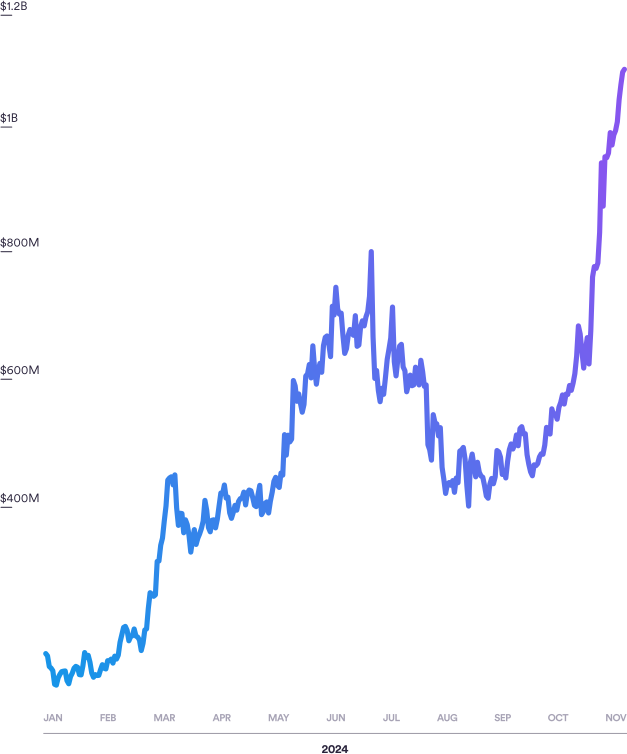
The chart above tracks the USDC/USD pair, highlighting the asset's consistent peg stability and consistent trading volume. This reliability makes it a dependable bridge currency for cross-border payments.
No comments yet. Be the first to share your thoughts!